
Mississauga’s population in 2025 is best placed in the high-780,000 to 800,000 range. The most recent official municipal estimate available is 780,747 residents as of July 1, 2024, published through Statistics Canada’s annual sub-provincial population estimates.
No finalized municipal-level July 1, 2025, figure has been released in a form that can be treated as official.
Any 2025 number, therefore, has to be a clearly defined estimate built on recent growth patterns, immigration trends, and housing capacity rather than a single authoritative census release.
Mississauga’s Most Recent Official Population Baseline
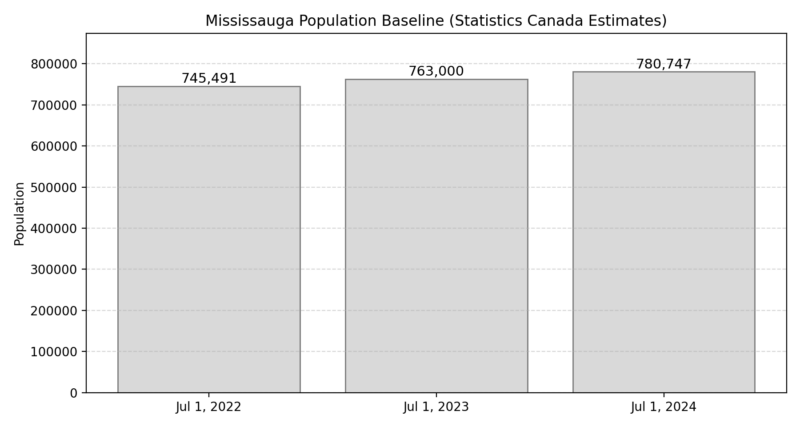
Statistics Canada produces annual population estimates for census subdivisions, including major cities, using July 1 as the reference date.
These estimates incorporate births, deaths, immigration, emigration, and interprovincial migration. For Mississauga, the latest finalized figure is for July 1, 2024.
This 780,747 figure is the number planners, demographers, and municipal analysts treat as the current official baseline going into 2025. Everything else is extrapolation.
How Fast Mississauga Has Actually Been Growing Recently
Between mid-2022 and mid-2024, Mississauga added over 35,000 residents. That pace is unusually strong for a built-out city with limited greenfield land and reflects broader GTA dynamics rather than local birth rates.
Using the 2022–2024 window:
Period
Population change
Percent change
Average annual growth
2022 → 2024
+35,256
+4.7%
~2.3% per year
A 2.3 percent annual growth rate is high by Mississauga’s historical standards. For much of the 2000s and early 2010s, annual growth often hovered closer to 0.5–1.0 percent as the city matured and greenfield development slowed.
This recent acceleration is largely driven by international migration rather than natural increase. Birth rates in Peel Region, like the rest of Ontario, have been declining for more than a decade, while immigration levels rose sharply after pandemic-era backlogs were cleared.
What Changed After 2021: Immigration and Housing Pressure
View this post on Instagram
Canada admitted over 430,000 permanent residents in 2022 and nearly 500,000 in 2023, the highest levels in national history. The GTA captured a disproportionate share of that inflow, and Mississauga benefited from proximity to Toronto, Pearson Airport, and established immigrant communities.
At the same time, Mississauga’s housing supply has shifted almost entirely toward high-density residential construction. Detached housing is largely built out.
Growth now comes from condominium towers, mixed-use developments, and intensification around transit corridors such as Hurontario Street and the Hazel McCallion LRT.
This matters because population growth is no longer constrained by land availability alone but by unit completions, household size trends, and affordability pressures.
Estimating Mississauga’s Population in 2025
Because there is no finalized July 1, 2025, municipal estimate yet, the responsible way to state a 2025 population figure is to show scenarios, not a single hard number.
Scenario
Assumption
Growth rate used
Estimated 2025 population
Conservative
Return to long-term mature-city growth
0.5%
~784,600
Moderate
Partial slowdown from 2022–2024 surge
1.0%
~788,600
High-growth
The recent trend continues
2.3%
~799,000
Under almost any reasonable assumption, Mississauga will have 785,000 residents in 2025. Only if immigration slows sharply or housing completions stall would the city remain near its 2024 level.
A figure around 790,000 is the most defensible single-number estimate for general reference, provided it is clearly labeled as an estimate rather than an official count.
How Mississauga Compares Within the GTA
Mississauga remains Canada’s seventh-largest city, but its growth profile differs from both Toronto and outer-ring municipalities.
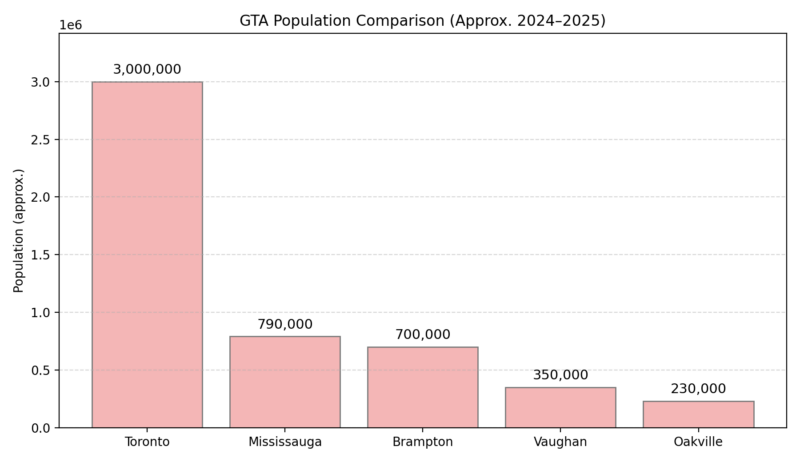
Mississauga sits in a transitional position. It is no longer a fast-expanding suburb, but it is not a static core city either. Its growth depends heavily on apartment construction and migration flows, not suburban sprawl.
Long-Range Forecasts and Why They Matter Less for 2025
Municipal and regional planning documents often project Mississauga’s population reaching 850,000–860,000 by 2031 and approaching one million by 2051. These projections are useful for infrastructure planning but are not designed to capture short-term volatility.
Long-range forecasts assume averaged conditions across decades. The post-2021 immigration surge shows how quickly real-world population change can diverge from smooth forecast curves. For a year like 2025, recent annual estimates matter far more than 30-year projections.
Key Factors that Will Shape Growth Beyond 2025
Several structural constraints suggest Mississauga’s growth rate will eventually moderate again:
Factor
Impact on population growth
Housing affordability
Smaller household sizes, slower in-migration
Limited land supply
Growth tied to high-rise approvals
Aging population
Lower natural increase
Federal immigration policy
High short-term volatility
Transit-oriented development
Localized density spikes
Mississauga is increasingly a vertical growth city, meaning population gains come in waves tied to project completions rather than steady annual increases.
Bottom Line
Mississauga enters 2025 with a population just under 800,000. The last confirmed official count places the city at 780,747 residents as of July 1, 2024, and every realistic growth scenario points to an increase in 2025 rather than stagnation.
Even under conservative assumptions, Mississauga surpasses 785,000 residents, while a continuation of recent immigration-driven growth pushes the city close to 800,000.
What matters most is not the exact headline number but the pattern behind it. Mississauga is no longer growing through land expansion or rising birth rates.
Its population change is now tightly linked to federal immigration policy, condominium construction, and transit-oriented density.
That makes year-to-year growth more volatile but also more predictable in direction. In 2025, the direction is clear: the city is still growing, but as a mature, high-density urban center rather than a suburban one.