
Brampton’s population in 2025 is best placed just under 800,000 residents, with continued growth year over year, but at a potentially slower pace than the post-2021 surge.
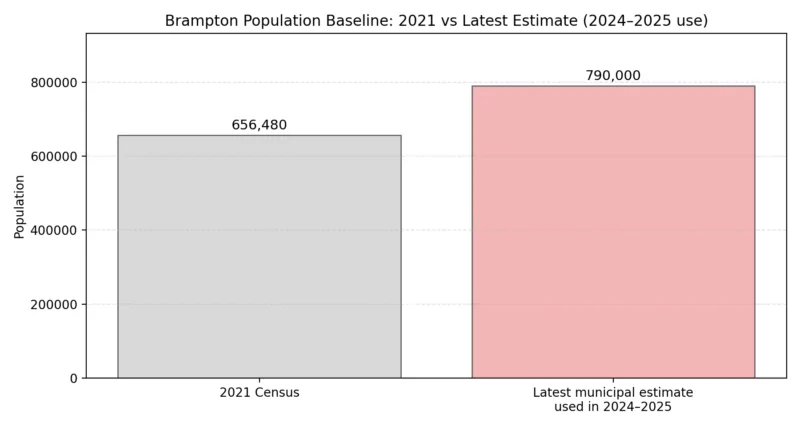
The most recent official municipal estimate available going into 2025 places Brampton at approximately 790,000 residents, up sharply from the 2021 Census count of 656,480.
The city is still growing in 2025, but the drivers, speed, and sustainability of that growth look materially different from what they did in 2022 and 2023.
The Latest Population Baseline for Brampton Is 2025 With
Population discussions around Brampton often blur together census counts, municipal estimates, and projections. They are not the same thing.
The 2021 Census remains the last fully enumerated count, while Statistics Canada’s annual population estimates provide the working “current population” used by planners and analysts between censuses.
This means Brampton added well over 130,000 residents in roughly three to four years following the 2021 census. That scale of growth is exceptional for a large Canadian city and immediately frames why Brampton’s population story is often discussed separately from slower-growing peers.
Year-Over-Year Growth – What the Numbers Actually Imply
Year-over-year growth at the municipal level is calculated using consecutive annual estimates rather than census counts. While individual annual figures fluctuate, the direction since 2021 has been unambiguous: strong positive growth every year.
To understand magnitude rather than fixate on a single annual percentage, it helps to translate the post-2021 increase into average annual terms.
Period
Approximate change
Average annual increase
2021 → 2024/2025
+130,000 to +135,000
~40,000 to 45,000 per year
Even if growth moderates in 2025, Brampton’s year-over-year increase remains measured in tens of thousands, not thousands.
That places it among the fastest-growing large municipalities in Canada on an absolute basis, not just a percentage basis.
Why Brampton Grew so Fast After 2021
View this post on Instagram
Brampton’s growth since 2021 cannot be explained by births alone. Like most Ontario cities, it has a declining fertility rate and an aging population. The real drivers sit elsewhere.
International Migration Is the Dominant Force
Canada admitted record numbers of permanent residents in 2022 and 2023, alongside a sharp rise in non-permanent residents such as international students and work permit holders.
The Greater Toronto Area absorbed a large share of these newcomers, and Brampton has long been one of the primary settlement destinations due to established communities, family networks, and access to employment corridors.
This is why Brampton’s population curve steepened dramatically after 2021, while many mid-sized Canadian cities saw more modest gains.
Housing Form and Household Size
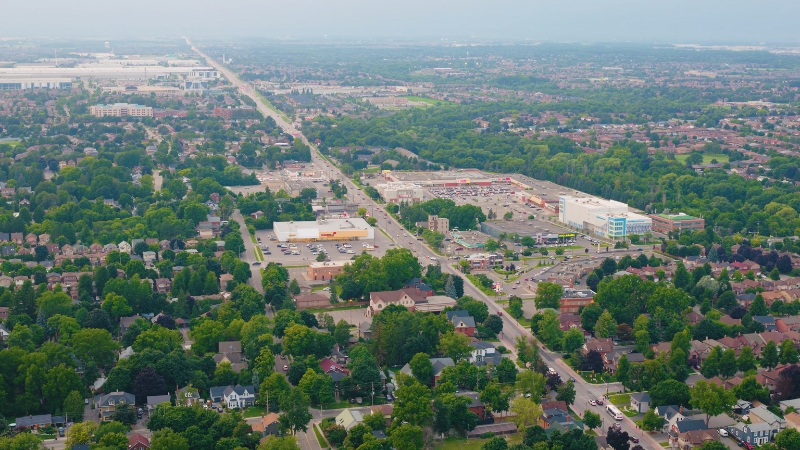
Unlike Toronto’s core, Brampton still contains extensive low-rise and townhouse neighborhoods that support larger household sizes. When immigration volumes rise quickly, the population can grow faster than housing unit counts because households double up.
This dynamic has been widely observed in Brampton and partially explains how population growth outpaced visible construction.
GTA Affordability Gradients
As housing costs rose sharply across Toronto and Mississauga, Brampton continued to act as a relative affordability valve within commuting distance of major employment centers.
Even when prices increased in Brampton itself, the price gap relative to Toronto continued to redirect demand.
What Changes in 2025: Why Growth May Slow but Not Reverse
The national context entering 2025 is different from the immediate post-pandemic years.
Federal policy has shifted toward slowing population growth, particularly by reducing the number of non-permanent residents. This matters for Brampton more than for many other cities.
At the same time, structural demand has not disappeared. The result is a likely deceleration, not a halt.
Factor in 2025
Effect on Brampton
Tighter immigration caps
Reduces extreme upside growth
Housing supply constraints
Limits how much population can be absorbed cleanly
Existing settlement networks
Continues to attract newcomers
Regional job access
Sustains in-migration from within the GTA
In practical terms, Brampton in 2025 is still growing year over year, but the pace is more sensitive to policy and housing conditions than it was in 2022–2023.
Estimating Brampton’s Population in 2025
Because there is no single official “2025 population number” released at the start of the year, the most responsible approach is to present a clearly defined estimate range rather than a fixed claim.
Using the latest municipal estimate as a starting point:
Scenario
Assumption
2025 population outcome
Lower growth
Sharp slowdown in newcomer inflows
~790,000 to 795,000
Moderate growth
Continued inflows with moderation
~795,000 to 805,000
High growth
Limited policy impact locally
~805,000+
A midpoint estimate places Brampton at around 800,000 residents during 2025, which aligns with both recent growth arithmetic and current policy signals.
How Brampton Compares to Neighboring Cities in 2025
Brampton’s scale is often underestimated when compared to better-known cities.
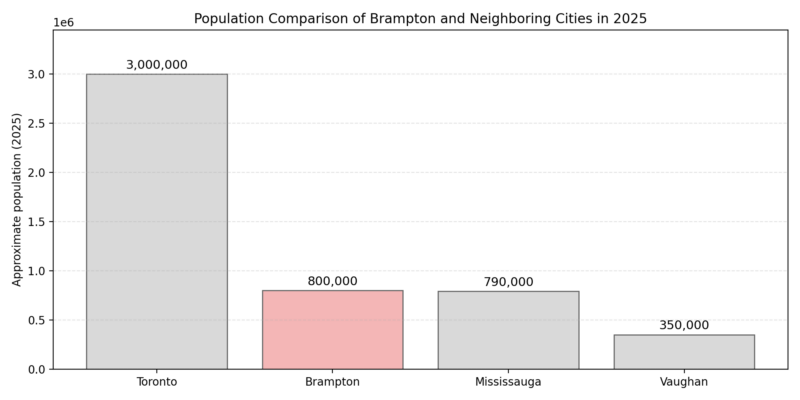
Brampton is no longer a secondary suburb in population terms. It now operates at a scale comparable to major Canadian cities, with infrastructure and governance pressures to match.
Long-Term Planning Expectations versus Near-Term Reality
Regional planning documents continue to allocate substantial future growth to Brampton, with projections pushing the city toward roughly one million residents by the early-to-mid 2050s.
These long-range numbers matter for transit, water, and housing policy, but they should not be mistaken for short-term forecasts.
The key takeaway for 2025 is that Brampton remains on a growth trajectory, but year-over-year changes will likely become less explosive and more uneven than they were immediately after 2021.
Bottom Line
@insauga Population of Brampton surpasses Mississauga for the first time ever. #brampton #mississauga #ontario ♬ News Background Song – Studio Pro Sound
Brampton is still growing in 2025, and the growth is real, large, and measurable. The city enters the year with a population of just under 800,000 residents, having added more than 130,000 people since the 2021 census.
Year-over-year growth continues, but the drivers have shifted. Immigration policy tightening and housing constraints are tempering the pace, even as long-standing settlement patterns and GTA affordability pressures keep population gains positive.